
Modash alternatives: Upfluence and Grin platforms compared
If you have been trialing Modash, Upfluence, or Grin and something is not clicking, you are not alone. Most brand marketers hit the same wall: the tool handles one part of the workflow well and leaves the rest on a spreadsheet. This article gives you an honest, side-by-side look at all three platforms, what each does well, where each falls short, and where Creator.co fits into the picture. No bait-and-switch. Just the comparison your buying decision actually needs.
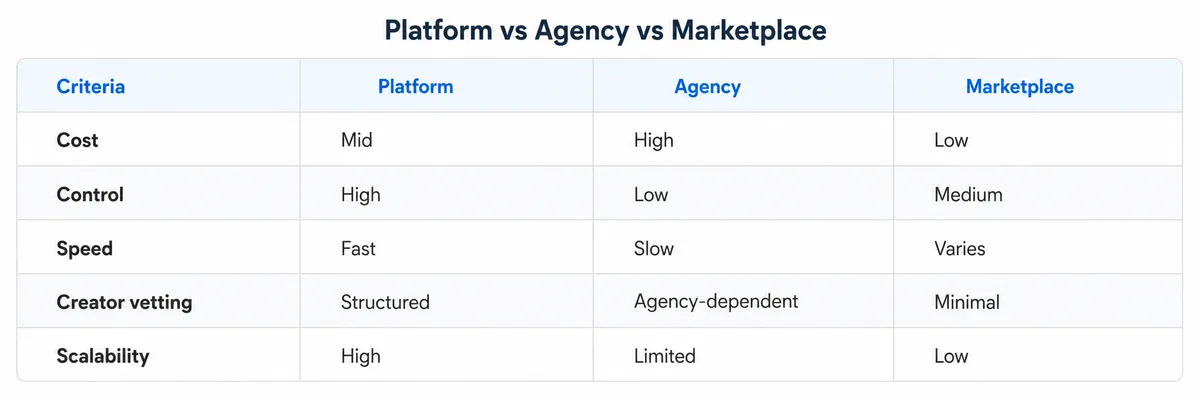
Why brands search for a Modash, Upfluence, or Grin alternative
The search for influencer marketing software alternatives usually starts with one of three friction points. First, discovery-only tools that stop at finding creators and hand everything else, outreach, contracts, content collection, payment, back to the team. Second, per-seat or search-credit pricing that scales badly as campaign volume grows. Third, creator data that skews heavily toward one platform, leaving brands flying blind on others.
The right replacement depends on where your bottleneck actually sits. A team that only needs discovery needs a different tool than a team running 50 campaigns a month. Before comparing platforms, pin down whether your pain is discovery, relationship management, or end-to-end execution.
Creator.co has been operating in influencer marketing since 2016, long enough to watch this category mature and see which gaps consistently cost brands the most time and money. Our influencer marketing guide for brands covers the full workflow if you need a framework before picking a platform.
What Modash does well, and where brands outgrow it

Modash is a strong discovery and analytics tool. Its creator database covers Instagram, TikTok, and YouTube, with solid audience-quality filters, fake-follower detection, and engagement analysis. For teams whose only job is vetting and shortlisting creators, it delivers.
The problem shows up once you have your shortlist. Modash is not built for outreach, contracts, content collection, or payment. Those steps move back into email threads and spreadsheets. For brands running more than a handful of campaigns, that gap gets expensive in hours.
Pricing is another friction point. Search-credit and tier limits push growing teams into higher plans quickly. A brand running 10 campaigns a month burns through credits faster than its budget expects.
Modash still makes sense for one specific buyer: a team that only needs discovery and vetting, and already has a separate system handling execution. If that is not your situation, you are paying for half a workflow.
At Creator.co, we screen for the same audience-quality signals Modash is known for: fake followers, engagement pods, and over-reliance on sponsored content. Switching platforms does not mean losing vetting rigor.
What Upfluence and Grin do well, and their trade-offs
Upfluence is strongest for DTC and ecommerce brands running affiliate-style programs. Its Shopify integration, promo code tracking, and creator search make it a practical choice for brands where every campaign needs to connect back to revenue. The trade-off is a heavier setup and enterprise-tier pricing that puts it out of reach for leaner teams.
Grin is built around creator relationship management. It treats influencers as long-term partners rather than one-off media placements, with CRM tools, content approval workflows, and deep ecommerce integrations. The trade-off is that Grin does not include a built-in discovery marketplace in the traditional sense. You bring your own creators. That works well for large in-house teams with established rosters, but it creates a gap for brands still building their creator base.
Both platforms sit on the execution-and-relationship side of the spectrum. Modash sits on the discovery side. Most brands need both halves, and end up paying for two tools or accepting half coverage from one.
Creator.co automates the four most time-consuming campaign steps: brief creation, creator recruitment, outreach, and tracking. Internal data shows brands save 15 to 20 hours per campaign compared to manual workflows. Brands that want to run creator-affiliate programs at scale, without juggling two platforms, can manage the full cycle in one place.
If long-term ambassador programs are part of your strategy, see our guide to building a brand ambassador program that drives real sales.
How Creator.co compares: discovery plus execution in one platform
Creator.co covers the full campaign workflow: discovery, vetting, recruitment, outreach, content collection, and performance tracking, without requiring a second tool or a manual handoff between stages.
The discovery layer includes 270,000 registered influencers on the platform and a 400 million creator database for outbound search, with geo, niche, platform, and audience filters. Brands can find creators in any market without being limited to a pre-curated list.
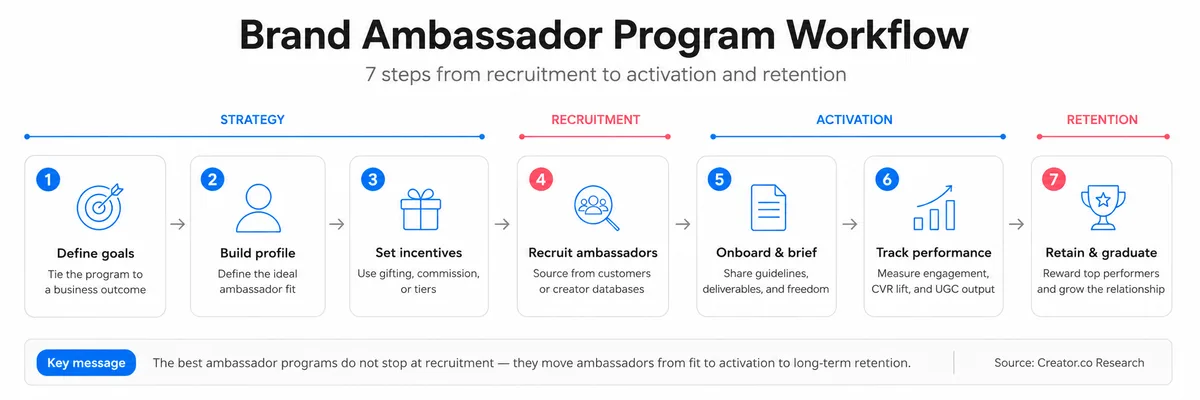
The automation layer is where Creator.co separates from discovery-only tools. Bulk outreach, automated email sequences, and message-flow triggers let small marketing teams run campaigns at a scale that would otherwise require a full operations headcount. Groupon used these tools to recruit and activate 800 creators in a single campaign, generating 3.7 million views.
Creator.co also pairs the platform with managed support. Brands are not left alone inside a tool. That matters most for teams that are new to running influencer programs at scale.
For brands focused on micro and nano influencer strategy, the platform's filtering tools make it straightforward to find and activate large cohorts of smaller creators without manual list-building.
Ready to run your first creator campaign?
Search 270K+ creators, manage briefs, and handle payments — all in one platform. Used by Nike, Fender, and 10,000+ brands.
Side-by-side comparison: pricing, data, workflow, and support
Creator.co earned a G2 Leader badge in Spring 2026 and holds the "Users Love Us" designation. Clients include Mercedes-Benz, Nike, Fender, Oakley, and Best Buy.
| Modash | Upfluence | Grin | Creator.co | |
|---|---|---|---|---|
| Primary strength | Creator discovery and vetting | Ecommerce and affiliate tracking | Creator CRM and relationship management | End-to-end campaign execution |
| Discovery database | Large, real-time (IG, TT, YT) | Yes, with ecommerce filters | Limited, bring-your-own focus | 270K registered + 400M database |
| Campaign execution | Not included | Yes | Yes | Yes, with automation |
| Outreach tools | Not included | Limited | Yes | Bulk outreach, automated sequences |
| Ecommerce / affiliate fit | Weak | Strong (Shopify, promo codes) | Strong | Moderate (affiliate tracking available) |
| Pricing model | Search credits and tiers | Enterprise quote | Enterprise quote | Subscription and managed tiers (est.) |
| Built-in payments | No | Yes | Yes | Yes |
| Best-fit team size | Small, discovery-focused | Mid-market to enterprise DTC | Large in-house teams | Small to mid-market, lean teams |
| Managed support | Self-serve | Self-serve, CSM at higher tiers | CSM at enterprise | Yes, included |
Note: all pricing described by model, not exact dollar amounts. Public pricing shifts frequently. Request a demo or trial from each vendor for current figures.
Upfluence genuinely leads on Shopify and affiliate integration. Grin genuinely leads on CRM depth for brands with large, established creator rosters. Modash genuinely leads on pure discovery breadth. The question is which gap hurts your operation the most.
How to choose the right platform for your brand
The decision comes down to three questions. Answer them before requesting demos.
Question 1: Where is your bottleneck? If you cannot find enough quality creators, your bottleneck is discovery. If your team spends most of its time on outreach and follow-up, your bottleneck is execution. If you struggle to maintain relationships with a roster you already have, your bottleneck is CRM.
Question 2: What is your team size and budget model? Per-seat and search-credit models reward small, light-volume teams. Flat subscription or managed models reward high-volume, lean teams. Choose the model that aligns with how your campaign count scales.
Question 3: Do you need ecommerce or affiliate tracking? If every campaign needs promo code attribution or Shopify revenue tracking at the order level, that integration must be native, not bolted on.
Mapped to recommendations: discovery-only teams with execution handled elsewhere, Modash. DTC brands running affiliate programs at scale, Upfluence. Large in-house teams managing long-term rosters, Grin. Teams that need end-to-end coverage without doubling their tool budget, Creator.co.
Switching costs are real but manageable. Creator lists and briefs carry over. The practical move is a pilot: run one campaign on the new platform before committing fully.
Reagan Anthony, Influencer Marketing Manager at Groupon, put the execution problem plainly: "Before Creator, recruitment was taking up most of my work week. It really allowed us to scale the recruitment process." That is the concrete outcome the right platform delivers.
See if our AI finds the right creators for your brand
London searches 175K+ vetted creators and builds your shortlist in under 3 minutes. No account, no credit card.
Ready to see where Creator.co fits in your stack? Find your creator shortlist, free, and compare it to what your current tool delivers.