
Community marketing: how brands build creator communities
Most brands treat influencer marketing as a series of transactions. Find a creator, brief them, post, move on. That model produces content. It does not produce loyalty, compounding reach, or a group of people who genuinely want your brand to win.
Community marketing is the alternative. It turns creators and customers into an active, connected group that markets the brand for you, not because they were paid for a single post, but because they belong to something. This article breaks down what that looks like in practice, how brands are doing it now, and how to build a creator community that compounds over time.

What community marketing actually means for brands
Community marketing is a strategy that builds an ongoing, relationship-driven group around your brand. Members share a common interest, identity, or goal. They create content, refer friends, and show up repeatedly without being re-acquired each time.
This is different from social media management. Posting consistently to an audience is broadcast. Community marketing creates dialogue and belonging between members, not just between brand and follower.
It is also different from a paid influencer buy. A one-off campaign rents attention. A brand community owns it. The relationship is ongoing, the content keeps coming, and the value compounds.
Most brands can build two communities at once: a customer or fan community, and a creator community. The creator community is the engine. Active, knowledgeable creators keep producing content that feeds and energizes the customer community around them.
Community building marketing is, at its core, a long-game asset. Measure it in retention, repeat activation, and organic advocacy, not in the spike from a single campaign.
Why community marketing matters now
Audiences trust people over ads. That shift has been building for years, but the data from the Ad Age Next Gen Summit 2025 makes it concrete. Tiff Baira of Street Hearts presented research showing Gen Z actively want to break from passive screen consumption and find shared-interest communities in real life. Brands like Covergirl, OkCupid, Captain Morgan, and Vera Wang are responding with IRL events that activate creator communities around live experiences.
The cost case is just as strong. Acquiring a new customer keeps getting more expensive across paid channels. A community that drives repeat activation and word-of-mouth referrals lowers your effective cost-per-acquisition over time. The reduction is directional rather than fixed, it varies by category and community maturity, but the mechanism is real.
Creator content for awareness also performs differently when it comes from an established community. Creators who already know and believe in the product produce more credible content, and audiences can tell.
Creator communities vs. one-off influencer campaigns
A transactional influencer model looks like this: brief a creator, approve a post, measure impressions, repeat from scratch next quarter. Each cycle starts cold. The creator re-learns the brand, the brand re-vets the creator, and the content often shows it.
A creator community model is the opposite. You recruit a cohort, keep them active across multiple launches and seasons, and the content gets faster, cheaper, and more on-brand with every cycle. Creators already know the product. Briefs get shorter. Revisions drop.
The compounding benefit is measurable. Influencer marketing built on a standing creator roster outperforms cold outreach on production speed and content quality over time.
Creator.co's Gen3 case study shows what this looks like at scale. Gen3 ran 16 brand activations with 579 activated creators and produced 591+ content pieces. What started as a test campaign became a repeatable, creator-powered engine because the community was maintained, not dissolved after each run.
Repeat creators also read differently to audiences. Someone posting about the same brand across multiple seasons looks like a genuine advocate. Someone posting once looks like a placement.
How to build a creator community around your brand
Building a creator community is not complicated, but it requires intention at each step.
Step 1: Define the community's purpose. Members need something to rally around beyond the product itself. A shared interest, an identity, or a cause. This is what makes the community feel real rather than transactional.
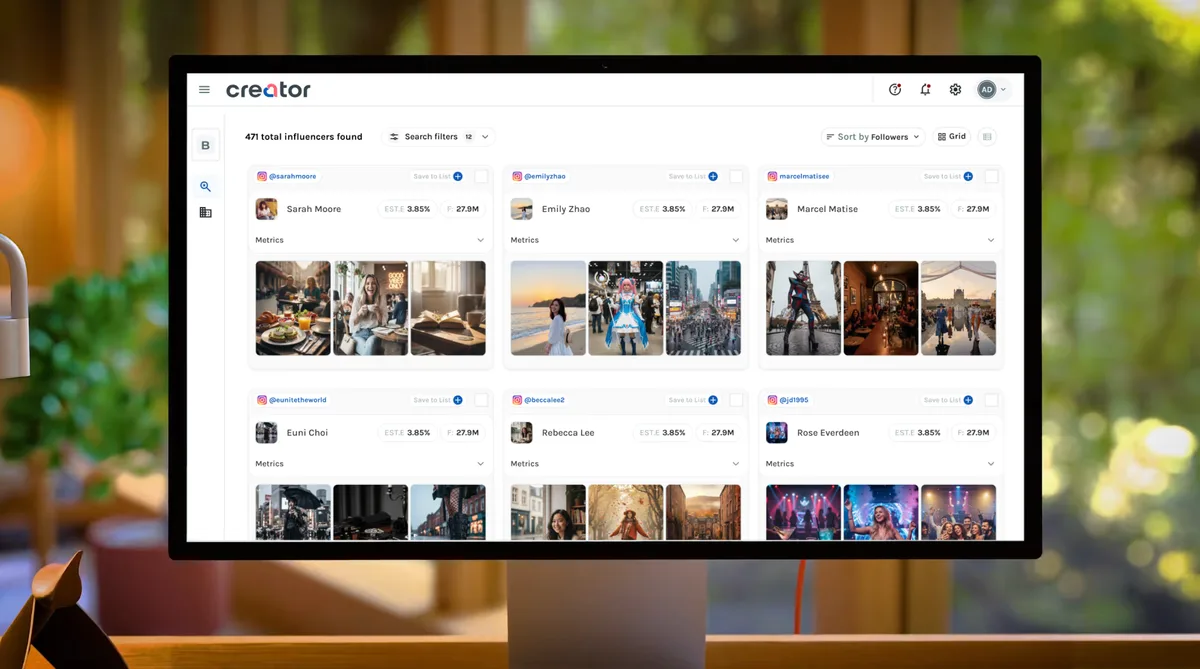
Step 2: Recruit the right creators. Nano and micro creators drive higher engagement rates and tend to feel more like peers to their audiences than celebrities do. Creator.co gives brands access to 270,000 registered influencers on the platform and a broader database of 400 million creators to source and refresh the roster over time.
Step 3: Give members a reason to stay. Early product access, exclusive drops, co-creation opportunities, formal recognition, and fair compensation all work. Any one of these is more effective than relying on goodwill alone.
Step 4: Activate on a rhythm. Launches, seasonal moments, and IRL events create recurring reasons for creators to produce content. One activation is a campaign. A calendar of activations is a community.
Step 5: Build feedback loops. Invite creators to shape product development and content direction. When members influence what the brand does, their loyalty deepens and their content becomes more specific and credible.
See if our AI finds the right creators for your brand
London searches 175K+ vetted creators and builds your shortlist in under 3 minutes. No account, no credit card.
Community-led growth in action: real brand examples
Community-led growth means your members do a meaningful share of the growth work. They invite, advocate, and create without a separate paid brief for every piece of content. The brands below have made this work in categories as different as outdoor retail and quick-service restaurants.
Oakley at Whistler. Creator.co activated local nano creators around Oakley Community Days, a live retail event in Whistler, British Columbia. The campaign generated 122K views, a 7.09% average engagement rate, and 26 content pieces from a single IRL moment. Local creators brought authenticity that a broadcast ad could not replicate. They were part of the community they were documenting.
TacoTime. Creator.co activated local creators across key TacoTime markets to drive community buzz and foot traffic. The campaign produced 300K+ views across a multi-location activation. Recurring local creators became familiar faces in their markets, not just paid posters.
The common thread across both is clear. Local, recurring creator activation tied to real-world moments builds a creator community that shows up again and again, not just for one post.
Charlotte Tilbury provides a prestige-launch variation. The brand activated a creator cohort around ten Disney 100-inspired makeup looks, turning a licensing moment into a community content event. High-end brands can run the same model. The channel and aesthetic change; the community logic does not.
How to measure a brand community
Vanity metrics will mislead you here. A community is not a campaign, and measuring it like one produces false conclusions.
Track these instead:
| Metric | What it tells you |
|---|---|
| Creator retention rate | Are the same creators activating across multiple campaigns? |
| Repeat activation rate | How many creators from one campaign run in the next? |
| Member-generated content volume | Is the community producing content independently? |
| UGC reuse in paid media | Is community content strong enough to run as an ad? |
| Referral and advocacy signals | Are community members driving sign-ups or purchases? |
Tie community metrics to business outcomes where the data allows. Repeat purchase rate and sell-through on community-activated launches are the clearest signals. CAC reduction is directional, and the timeline is quarters, not weeks.
Community activity is also easier to track when it is managed in one place. Creator.co handles recruitment, activation, and measurement on a single platform, so community data is not scattered across spreadsheets and inboxes. When everything is centralized, patterns become visible across campaigns.
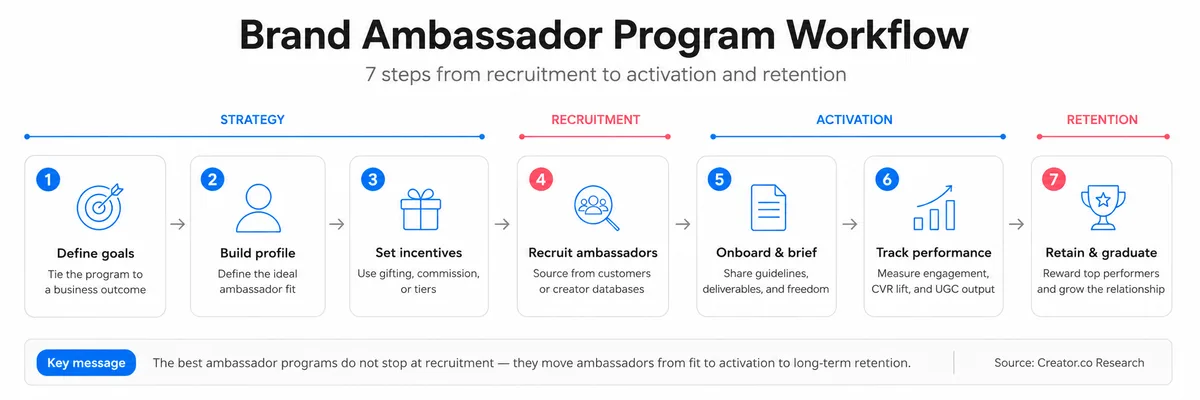
Once your best creators are consistently activating and generating results, formalizing that relationship through a brand ambassador program is the logical next step.
Turn your creator community into a durable asset
One-off campaigns produce content. A creator community produces content, advocacy, and compounding brand equity over time. The difference is in the relationship.
The brand-side payoff is concrete. A standing creator roster lowers your effective CAC over time, speeds up content production, and generates authentic advocacy at scale. These are not soft benefits. They show up in campaign economics across seasons.
The path from here is straightforward. Start with a defined community purpose. Recruit nano and micro creators who already fit that identity. Activate them on a rhythm. Measure retention, not just reach. And when your top creators start behaving like genuine advocates, move them into a formal brand ambassador program to deepen the relationship and the results.
Community-led growth is not a trend. It is the structural advantage that compounds while your competitors keep paying to re-acquire the same attention.
Ready to run your first creator campaign?
Search 270K+ creators, manage briefs, and handle payments — all in one platform. Used by Nike, Fender, and 10,000+ brands.