
The real question isn’t whether an agency or platform is better. It’s how much time, expertise, and internal bandwidth your team has to actually run influencer marketing.
This guide gives you the comparison framework that most agencies and platforms won't show you, because it requires being honest about where each model falls short. By the end, you will know which model fits your brand's size, internal resources, and campaign goals not a vague "it depends."
The real cost of choosing the wrong model
Picture a mid-market DTC brand that commits $60,000 to a 6-month agency retainer. The agency delivers 9 influencer posts. The campaign performs fine. Then the CMO learns that a self-serve platform could have activated the same creator tier in under 72 hours for a fraction of that budget.
That is not a hypothetical. It is the conversation that happens in post-mortems across the industry every quarter.
The stakes are real and rising. Goldman Sachs projects influencer marketing will reach $480 billion by 2027. Brands that pick the wrong model early either overpay for managed services or under-execute with the wrong tooling. Neither outcome is neutral, and neither gets easier to reverse as budget cycles compound.
Before you commit to any model, you need a shared definition of what is actually on the table. Three distinct models exist in this space, and they are not synonyms even though the industry uses them interchangeably:
Traditional influencer marketing agency — a fully managed service
Self-serve influencer marketing platform — a software layer your team operates directly
Creator marketplace — a searchable directory where brands source and contract creators independently
This guide maps all three. Start with what an influencer marketing strategy built on each model actually looks like in practice.
What an influencer marketing agency actually does (and what it doesn't)
An agency handles the full campaign lifecycle: strategy, creator identification, outreach, contract negotiation, brief writing, content review, posting coordination, and reporting. The brand's role is largely approval-based. The agency runs the operation; you review and sign off.
That model is genuinely the right fit for three specific brand profiles:
Brands with no internal influencer headcount and a campaign budget above roughly $75,000, where the cost of hiring and training an internal team exceeds the agency management fee
Brands running complex multi-market or multi-platform campaigns that require deep creator relationship infrastructure built over years
Brands launching influencer marketing for the first time who need strategic architecture before they can self-serve effectively
The problem is that agencies have a structural volume ceiling. Most boutique and mid-tier firms manage 25 to 75 creators per campaign before quality degrades. When Groupon ran a campaign activating 800 creators and generating 3.7 million views, no traditional agency managed that at speed. Volume at that scale requires a different infrastructure.
Cost structure matters here too. Agency retainers for mid-tier firms typically run $5,000 to $25,000 per month. Full-service campaign management adds 15 to 25% overhead on top of creator fees. That overhead is justified when the strategic and operational lift is genuinely complex. It is not justified when the primary task is creator discovery and brief distribution, which platforms automate.
Agencies also typically do not provide real-time campaign dashboards, direct brand-to-creator messaging, content usage rights management at scale, or post-campaign content libraries. Those gaps matter if you are running always-on programs or repurposing creator content in paid media.
What an influencer marketing platform gives you instead
A self-serve platform removes the agency intermediary. Your team logs in, filters a vetted creator database by niche, audience demographics, engagement rate, and follower tier, sends briefs, manages deliverables, and tracks results in one place.
The speed difference is significant. Brands using Creator.co report saving 15 to 20 hours per campaign on creator discovery and outreach alone, hours that would otherwise go to cold email sequences, DM threads, and spreadsheet tracking.
The Creator.co workflow runs in four steps:
Search 270,000+ vetted creators filtered by platform, niche, location, and audience data
Post a campaign brief to the marketplace and receive opt-in applications from relevant creators
Review content for approval before it goes live
Track real-time performance in a unified dashboard
That is the "platform does it in an afternoon" scenario from the opening section. It is not theoretical; it is the standard workflow for brands running micro and nano influencer campaigns at volume.
Platforms also support the UGC use case directly. Creator.co enables brands to commission licensed UGC content for use in paid ads, email, and on-site. Most agencies charge significant additional fees to facilitate content licensing. On a platform, usage rights are built into the campaign agreement from the start.
Creator.co holds a G2 Leader badge in influencer marketing software, which represents third-party validation from verified users, not self-reported metrics.
See if our AI finds the right creators for your brand
London searches 175K+ vetted creators and builds your shortlist in under 3 minutes. No account, no credit card.
Side-by-side comparison: agency vs. platform vs. creator marketplace
The fastest way to make the right call is to see the tradeoffs in one place.
Factor | Influencer marketing agency | Influencer marketing platform | Creator marketplace |
|---|---|---|---|
Typical cost | $5K–$25K/mo retainer + creator fees | Platform subscription + creator fees (no management markup) | Pay-per-creator or subscription; lowest overhead |
Brand control | Low — agency manages relationships | High — brand manages directly | High — brand selects and contracts directly |
Time to launch | 4–8 weeks (strategy, outreach, negotiation) | 24–72 hours (post brief, receive applications) | 24–48 hours |
Creator vetting | Agency-curated (opaque, relationship-based) | Platform-verified (audience authenticity, engagement data) | Platform-verified; brand reviews profiles |
Scalability | Low–Medium (25–75 creators without quality drop) | High (hundreds of creators simultaneously) | High |
Content and usage rights | Negotiated case-by-case; often unclear | Built into platform agreements; brand retains rights | Configurable per campaign |
Reporting and analytics | End-of-campaign report (often PDF) | Real-time dashboard | Real-time dashboard |
Best for | Large budgets, no internal team, complex strategy | Growth brands, in-house teams, volume campaigns | DTC brands scaling UGC and social proof |
The agency model is not wrong. It is a fit problem. Brands paying agency rates for work a platform automates in hours are leaving real budget on the table. Brands trying to self-serve a global, multi-language, multi-platform launch without strategic infrastructure will under-execute.
Charlotte Tilbury ran a Creator.co platform campaign that delivered a 341% ROI. That result came from volume, speed, and direct brand control — not from agency management.
The hybrid reality is also worth naming directly. Many brands at $50M+ in revenue, run a platform for execution while keeping an agency or in-house strategist for planning. The models are not mutually exclusive, and the right structure often combines both.
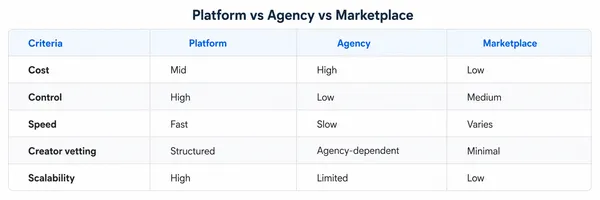
Comparison of three influencer marketing approaches: platforms offer high control and speed with mid-range costs, agencies provide expertise but at high cost with slower timelines, while marketplaces enable low-cost access with minimal vetting and scalability constraints.
When to use an agency, when to use a platform, when to combine both
This section gives you three explicit paths, not a "it depends" hedge.
Use an influencer marketing agency if: You have a campaign budget above $75,000, no internal influencer marketing support, and you are building a program from zero that needs strategic architecture. Agencies can also be a strong fit for regulated industries like finance and pharma, where campaigns require more rigorous legal, compliance, and content review.
Use an influencer marketing platform if: You have at least one in-house marketer owning influencer or UGC, a campaign budget between $5,000 and $75,000, and a need for speed, volume, or direct creative control. Particularly strong for DTC brands running always-on UGC programs for paid social. If you want to use creator content in paid media, a platform gives you the rights framework and the content library in one place.
Combine both if: You are a $50M+ brand running quarterly flagship campaigns (agency for strategy and hero talent) while also running continuous micro and nano creator activations (platform for volume execution). The agency manages 10 macro creators. The platform manages 200 nano creators simultaneously.
One stat anchors why the platform model keeps gaining ground regardless of brand size: 80% of consumers say authentic user-generated content influences their purchase decisions more than brand-produced content. Volume-sourced authentic content is not a nice-to-have. It is a purchase driver.
What to look for when you hire influencers at scale
Whether you are using an agency or a platform, the quality of your creator vetting process determines campaign ROI. These are the 5 non-negotiable criteria to apply before you hire influencers for any campaign.
1. Audience authenticity score Flag accounts where the follower-to-engagement ratio falls below 1 to 2% for accounts above 100,000 followers. Use platform tools rather than manual checks. Creator.co surfaces this data at the browse stage, before you select anyone.
2. Audience demographic match Age, location, and gender data must align with your buyer persona before outreach, not after content posts. A creator with 200,000 followers in the wrong geography is a wasted budget line.
3. Content quality consistency Review 90 days of posts, not just pinned content. Look for lighting quality, caption depth, and comment sentiment. Pinned posts are often a creator's best work, not their typical output.
4. Previous brand partnership behavior Check for over-saturation: 10 or more brand posts per month signals audience fatigue. Also check for undisclosed ads. Undisclosed sponsorships are an FTC compliance risk that transfers to the brand, not just the creator.
5. Brief comprehension Require creators to confirm brief receipt by answering a specific question from the document. This filters for professionalism before any contract is signed.
Red flags for fake follower activity include sudden follower spikes visible on Social Blade, comment-to-like ratios under 0.5%, generic comments like "Nice post!" with fire emojis, and geographic audience mismatch — for example, a US beauty creator with 70% of their audience located in Southeast Asia.
Creator.co automates this vetting layer. The data surfaces during browsing, not after selection. That is the operational difference between running a creator marketplace search manually and running one through a platform that has already processed the signal for you.
Calculate engagement rate for any creator
Paste a profile URL and get an instant engagement benchmark — see how any creator stacks up before you commit budget.
Making the right call for your brand
The agency vs. platform decision is not about which model is better in the abstract. It is about matching the model to your internal resources, campaign volume, and budget ceiling.
If your team needs full-service management and can absorb the cost, a traditional influencer marketing agency delivers strategic lift that a software subscription cannot replicate. If your team has the bandwidth to manage creator relationships directly and needs speed, volume, and content rights built in, a self-serve platform returns more value per dollar spent.
Most brands reading this guide are at the point where the platform model makes more sense than they initially assumed. The vetting is automated. The creator network is vetted and searchable. Content rights are built into the agreement. And the campaign can launch in 72 hours, not 6 weeks.
Creator.co gives brands access to 270,000+ vetted creators across every major platform, with built-in audience analytics, real-time reporting, and UGC licensing — without the agency markup.
Find the right creators for your next campaign on Creator.co.
Ready to run your first creator campaign?
Search 270K+ creators, manage briefs, and handle payments — all in one platform. Used by Nike, Fender, and 10,000+ brands.