
AI marketing agent: how brands use agentic AI for campaigns
Most marketing teams have already experimented with AI. They have used it to write copy, generate briefs, summarize reports. And for the most part, those experiments produced modest gains: a little time saved here, a little faster there. What they did not do is change how campaigns actually run.
That changes with agentic AI. An AI marketing agent does not wait for a prompt. It executes a defined sequence of tasks autonomously, across systems, without a human in the loop at each step. For brand marketers running influencer and creator campaigns, this is the shift that matters. Not smarter text suggestions. Actual execution.
This guide explains what an AI marketing agent is, how the category differs from generative AI tools, and how brands are using agentic AI to run campaigns faster and at a scale that was not practical two years ago.
What an AI marketing agent actually is (not a chatbot, not a copilot)
The influencer marketing category is crowded with tools calling themselves “AI,” but the capabilities behind that label vary widely. Most function as copilots: they generate recommendations or content, then rely on a human to decide and execute the next step. AI marketing agents go further. They can plan, make decisions, take action, and move workflows forward autonomously without requiring human input at every step.
The distinction becomes clearer when you map the three tiers of AI marketing tools:
Tier | What it does | Example task | Human labor still required? |
|---|---|---|---|
LLM tools | Generate text outputs | Draft a creator outreach email | Yes, find creator, personalize, send, track |
Generative AI marketing tools | Produce assets and drafts | Write a campaign brief from inputs | Yes, review, approve, route |
Agentic AI | Plans, decides, and executes across systems | Identify 40 matched creators, score them, send personalized outreach | Minimal, approval gates only |
Each tier is useful. Only one changes the unit economics of campaign execution.
Gartner's 2025 AI predictions estimated that 15% of day-to-day work decisions will be made autonomously by AI agents by 2028. The brands adopting agentic tools now are building a speed compounding advantage before that becomes standard. The parallel to SaaS replacing spreadsheets is accurate: agentic marketing tools are replacing the human-as-orchestrator for repeatable campaign tasks. Agentic marketing is a category shift, not a product feature.
What AI marketing agents can do in 2026
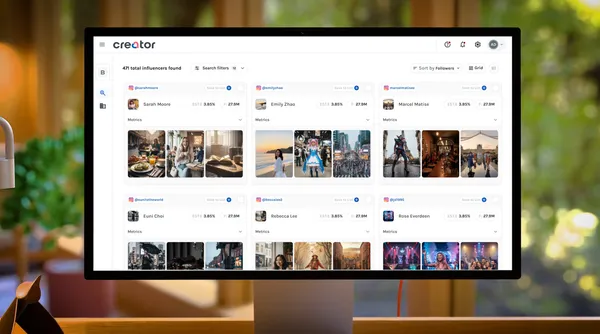
Creator.co's influencer discovery platform makes it easy to search and evaluate creators by engagement rate, follower count, and content performance.
The clearest proof of what an AI marketing agent can do today is the Creator.co London AI agent. A brand submits a product URL. In under 3 minutes, the agent returns a shortlist of matched creators. That benchmark is specific, and the mechanics behind it are worth understanding.
The agent parses the product URL for category, brand tone, and target audience signals. It cross-references those signals against Creator.co's network of 270,000+ opted-in creators and a dataset of 400M+ audience data points. It filters by relevance score, past campaign performance, and audience authenticity signals. Then it returns a ranked shortlist with rationale attached to each recommendation.
That sequence, done manually, takes a brand manager 6 to 10 hours for an initial longlist. The agent completes it before most teams finish their morning standup.
What remains human: final creative judgment on brief tone, relationship-building with creator partners, and strategic pivots when mid-campaign data signals something unexpected. The goal is not full automation. It is removing the friction from the high-volume, repeatable work so that human judgment goes toward decisions that actually require it.
Adjacent capabilities expanding in 2026 include real-time campaign optimization mid-flight, automated performance reporting with natural-language summaries, and dynamic budget reallocation based on early performance signals. The AI marketing tools for brands complete guide covers the broader platform landscape if you want a wider view of the category.
How brands are using agentic AI for influencer marketing
Influencer marketing is the highest-friction campaign type for an AI marketing agent to solve. Discovery is manual. Outreach requires personalization. Matching demands judgment across dozens of variables. Performance attribution is fragmented across platforms. This is exactly where the ROI case for agentic AI is strongest.
The London AI agent handles four specific workflow stages that previously required significant human hours:
Discovery at scale. The agent filters 270,000+ creators across 30+ variables: niche, audience demographics, engagement authenticity, brand safety signals, and past brand category performance.
Brief generation. From a product URL and brand inputs, the agent drafts a tailored campaign brief without a human building it from a blank doc.
Personalized outreach. The agent writes creator-specific messages that reference content style and audience fit, not generic copy-paste templates.
Performance analysis. Mid-campaign, the agent surfaces which creators are over- or underperforming and flags recommended actions.
The speed gain compounds across a quarter. Faster time-to-launch means more campaign iterations. More iterations produce more performance data. Better data improves future matching. Manual workflows cannot generate that flywheel.
Creator.co's matching logic is trained against outcomes from 10,000+ real campaigns, not just surface-level creator metrics. That data moat is the reason matching quality improves over time in ways that a tool with a smaller data foundation cannot replicate. Creator.co's recognition as a G2 Leader in Spring 2026 reflects third-party validation that platform execution matches the claims.
For brands building out creator programs, the influencer marketing complete guide for brands is the right starting point before deploying agentic tooling.
See if our AI finds the right creators for your brand
London searches 175K+ vetted creators and builds your shortlist in under 3 minutes. No account, no credit card.
LLM marketing vs. agentic marketing, what's the difference and why it matters for ROI
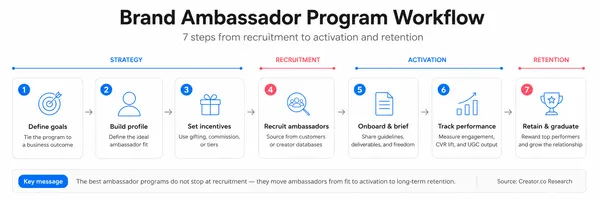
The complete brand ambassador program workflow spans seven strategic steps, from initial strategy and recruitment through activation and long-term retention to maximize influencer partnership ROI.
LLM marketing tools produce outputs. Agents produce outcomes. That single distinction is where the ROI framing lives.
An LLM tool gives you a draft outreach email. You still need to find the creator, personalize the message, send it, track the response, and follow up. An AI marketing agent does all of it. The gap between those two workflows is where margin lives for any team running campaigns at volume.
Generative AI marketing tools were a meaningful step forward: they improved content production speed and removed blank-page friction. But they did not change campaign operations. Agentic AI changes operations. For brands already evaluating a new category of tooling, that distinction validates why the evaluation is right.
There is also a risk to name directly: LLM-as-agent theater. Some tools wrap a GPT interface with a chat window and market it as an agent. The tell is simple. If the tool requires a human to copy-paste outputs between steps, it is not agentic. Every action that requires a human prompt is a workflow gap, not a workflow solution.
McKinsey's 2024 State of AI report found that organizations using AI primarily for content generation saw productivity gains of roughly 15 to 20%. Organizations deploying AI for workflow automation saw gains of 40 to 60% in targeted functions. The gap between those two outcomes is what an AI marketing platform built for execution, not suggestion, is designed to close.
What to evaluate in an AI marketing platform, 5 criteria
Brand marketers evaluating platforms need a fast, defensible framework. Here are 5 criteria that cut through vendor positioning quickly.
1. Does it execute or just suggest? Ask any vendor directly: "What does your platform do without a human in the loop?" If the answer involves words like "drafts" or "recommends," you are looking at a copilot. Copilots are useful tools. They are not agentic AI influencer marketing platforms.
2. Data source quality and size. Creator matching quality depends entirely on the underlying database. Ask how many creators are in the network, how fresh the data is, and whether audience data is first-party or panel-estimated. Creator.co's 270,000+ creators are opted-in, and the 400M+ audience data points are not scraped estimates.
3. Human-in-the-loop controls. The best agentic platforms let brands define approval gates: campaign brief sign-off, final shortlist review, outreach tone approval. Full automation without brand control is a liability, not a feature. Any platform that cannot explain its approval architecture is worth treating with caution.
4. Integration with your existing stack. An AI marketing agent that lives in a silo creates a new coordination problem. Ask whether it can push to your CRM, pull from your product feed, and connect to your analytics dashboard. Agentic value compounds when it connects to existing systems, not when it requires a new workflow island.
5. Attribution and performance feedback. The agent needs to close the loop. If it cannot connect outreach to engagement to conversion to campaign insight, it cannot improve its own matching over time. Ask specifically: "Does campaign performance data feed back into your matching model?" That feedback loop is the compounding advantage.
Red flag: If the primary interface is a chat window and every action requires a new human prompt, you are paying enterprise pricing for a better ChatGPT wrapper.
The brands winning with agentic marketing in 2026
The brands seeing the largest lift from agentic tools in 2026 share three traits. They run high-volume campaigns, typically multiple launches per quarter. They have a defined audience that maps cleanly to creator segments. And they had already systematized their brief and approval process before layering in agentic automation. Agentic tools amplify existing processes. They do not fix broken ones.
Across 10,000+ campaigns on Creator.co, the clearest predictor of campaign ROI is speed-to-launch. Brands that move from brief to live campaign in under 72 hours consistently outperform those with two-week-plus cycles. This pattern holds across categories: DTC skincare, apparel, food and beverage, consumer tech. Speed is not just an operational metric. It is a performance variable.
The compounding math is straightforward. Faster launches mean more campaigns per quarter. More campaigns generate more performance data. Better data produces better AI matching. Better matching accelerates future launches. This flywheel is structurally inaccessible to brands still running manual discovery and outreach workflows.
Looking forward 12 months, agentic marketing will move from early adopter advantage to table stakes for performance-focused brands. The platforms that survive will be the ones with proprietary data moats and execution infrastructure, not just LLM access. The gap between brands using agentic tools and those running campaigns manually will look like the gap between brands that adopted programmatic advertising in 2014 and those that waited until 2018. That gap was not recoverable.
For brands building the supporting content infrastructure around creator campaigns, UGC ads: how brands use creator content in paid media is a practical companion to the agentic marketing layer.
If you are evaluating where to start with AI for influencer marketing, the fastest entry point is letting the agent show you what it can find. No brief required. Just a product URL.
Ready to run your first creator campaign?
Search 270K+ creators, manage briefs, and handle payments — all in one platform. Used by Nike, Fender, and 10,000+ brands.
About the author: Vinod Varma is Co-Founder and CEO of Creator.co, the AI influencer marketing platform connecting brands with the right creators to run campaigns that drive results.