
Why brands are moving budget toward UGC platforms right now
Goldman Sachs projects global influencer marketing spend will hit $480 billion by 2027. That number reflects a fundamental shift in how brands allocate creative budgets, not a temporary trend. Paid social CPMs keep climbing while organic reach shrinks, and traditional studio production costs can't scale to match the volume modern campaigns require.
The performance data backs the shift. Ninety-four percent of shoppers visit a retailer after seeing creator content, according to research from Influencer Marketing Hub. That's not brand awareness, that's bottom-funnel behavior driven by content that feels real rather than produced. If you want to understand what UGC is and why it performs at this level, the short version is trust: consumers respond to people, not polished ads.
The pressure brands feel right now comes down to one decision: how do you actually source and manage UGC at scale? Three models exist, and choosing the wrong one costs time, money, and creative quality. A UGC platform, a UGC agency, and a UGC marketplace all promise creator content, but they operate very differently.
UGC platform vs. UGC agency vs. UGC marketplace: what's the difference?
A UGC platform is software that connects brands directly with vetted creators through a managed workflow. Brands post briefs, creators apply, content gets delivered, reviewed, and licensed inside one system. A UGC platform gives you speed, control, and scalability without outsourcing decisions to a third party.
A UGC agency is a service business. You pay for human account management, strategy, and production coordination. Agencies suit brands that want hands-off execution, but costs are higher, turnaround is slower, and you're dependent on a team's bandwidth and relationships.
A UGC marketplace is a directory where brands browse creator profiles and make direct contact. There's minimal vetting, no workflow infrastructure, and licensing is often left to individual negotiation. Marketplaces are low-cost entry points, but they rarely deliver at the volume or consistency B2B and DTC brands need.
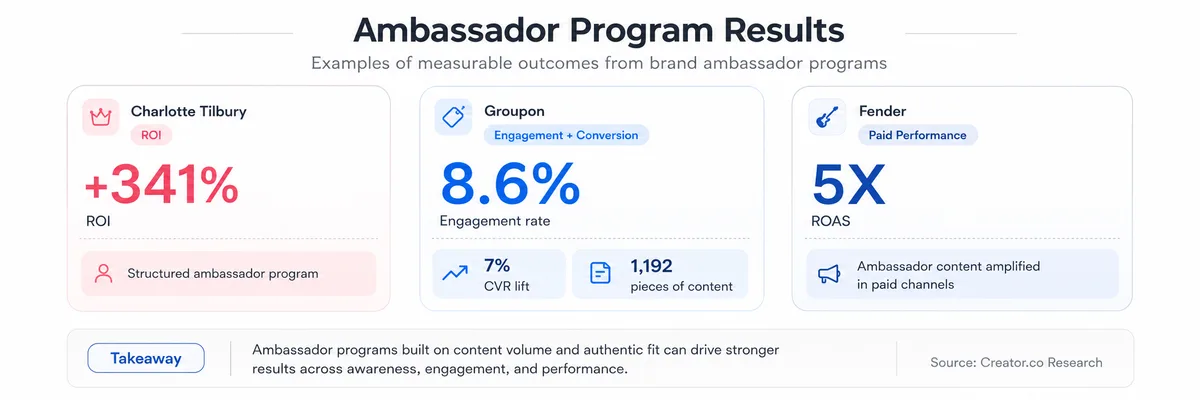
Real-world results from brand ambassador programs demonstrate significant ROI and performance lift. Data shows how structured ambassador initiatives with authentic creator fit drive engagement, conversions, and return on ad spend across different industries.
Here's how the three models stack up on the criteria that matter most to growth-stage brands:
Creator.co operates as a full-stack UGC platform, recognized as a G2 Leader in Spring 2026, and trusted by brands including Mercedes-Benz, Nike, Fender, and Oakley. That client roster matters here: those aren't brands that tolerate inconsistent creator quality or slow delivery.
What to look for in a UGC platform: 5 criteria that matter
Not every platform delivers the same results. Before committing to a vendor, evaluate these five factors.
Creator pool size and quality. Volume without quality creates noise. The strongest platforms maintain large, verified databases while filtering for content performance, not just follower count. Creator.co has 270,000+ registered creators and access to a broader database of 400 million profiles. That depth means brands can find niche-specific creators, not just whoever is available this week.
Brief-to-content speed. Time is a real cost. A platform that takes three weeks to deliver a first batch of content kills your campaign momentum. Look for platforms where creators can receive, accept, and begin producing content within days of brief submission. The best platforms treat speed as a product feature, not an afterthought.
Content rights and licensing. UGC only has value if you can use it. Confirm exactly what you're licensing: paid social, organic, web, email, out-of-home. Ambiguous licensing terms create legal exposure, especially for brands running high-spend paid social campaigns that pull directly from creator content. Rights should be clear, documented, and perpetual for the use cases you need.
Workflow automation. Managing UGC campaigns manually across spreadsheets, email chains, and separate payment tools costs teams 15 to 20 hours per campaign on average. A capable platform automates briefing, creator communication, content review, approvals, and payments in one place. That time saving compounds across multiple simultaneous campaigns.
Performance data and reporting. Content that performs once is useful. Content that you can analyze and replicate is an asset. Platforms that connect creator content to downstream metrics, engagement rates, click-through, conversion, and ROAS, let you build on what works and cut what doesn't.
Understanding how influencer campaigns and UGC campaigns complement each other is equally important for brands scaling both content types. How influencer and UGC campaigns work together breaks down how to run them in parallel without duplicating effort.
See if our AI finds the right creators for your brand
London searches 175K+ vetted creators and builds your shortlist in under 3 minutes. No account, no credit card.
How top brands find UGC creators that actually convert
The most common mistake brands make when sourcing UGC creators is optimizing for quantity. Running a high volume of content through creators who don't match the brand's audience produces waste, not results.
The better approach is a structured brief-to-application model. When a brand posts a clear, specific brief on a platform like Creator.co, relevant creators apply directly. That inversion matters: instead of brands hunting for creators, creators self-select based on alignment with the brief. The result is higher-quality matches and faster production timelines.
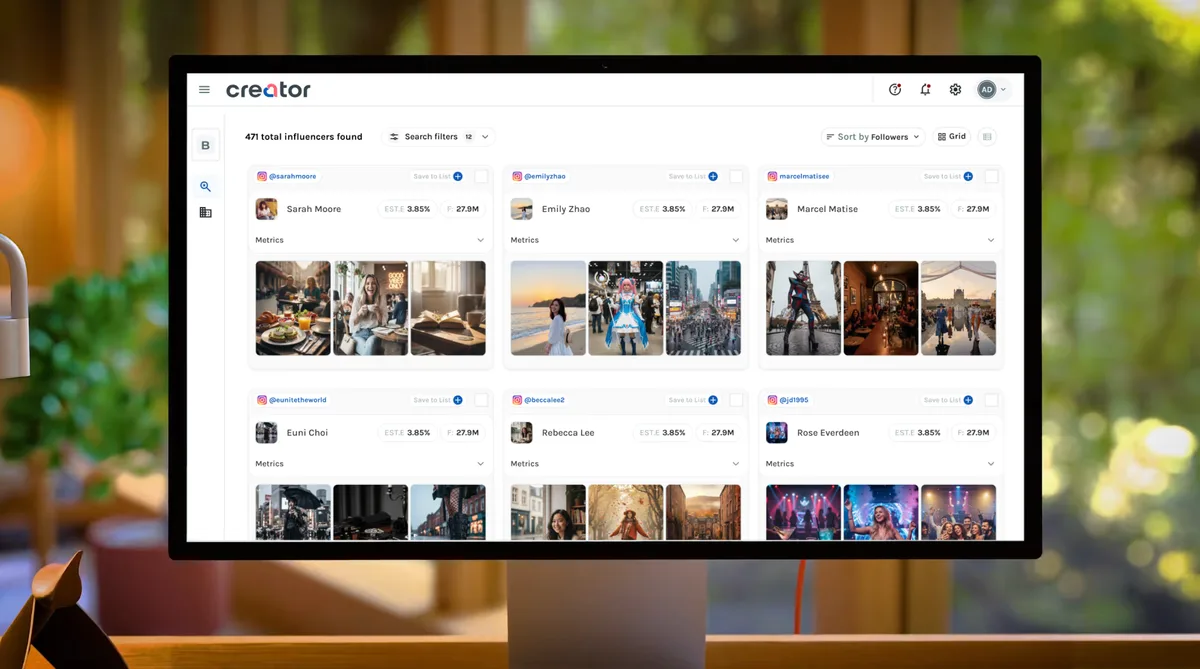
Creator.co's influencer discovery platform makes it easy to search and evaluate creators by engagement rate, follower count, and content performance.
Filtering criteria should include content category, past performance data, audience demographics, and platform focus (TikTok vs. Instagram vs. YouTube Shorts behave differently). A strong platform surfaces this information before you commit to a creator, not after you've paid for content that misses the mark.
The Groupon campaign run through Creator.co illustrates what structured creator selection produces at scale. Groupon generated 1,192 pieces of creator content through the platform, achieved an 8.6% engagement rate, and recorded a 7% lift in conversion rate. That output required a system capable of coordinating dozens of creators simultaneously, with consistent brief adherence and quality control throughout.
For brands actively searching for UGC creators, a platform's inbound application model removes the manual sourcing burden. Post a brief, set your criteria, review applicants, and greenlight the creators who fit. The process is repeatable across every campaign.
UGC platform results: what benchmarks should brands expect?
ROI benchmarks for UGC vary by brand category, campaign objective, and creative quality. But the data from brands running campaigns through structured platforms sets a useful reference point.
Charlotte Tilbury achieved a 341% ROI on a creator campaign, outperforming paid social benchmarks the brand had established with traditional production. Fender reached 5X ROAS on creator campaigns, which speaks specifically to performance on paid channels where UGC content was deployed as ad creative.
Both results share a common driver: creator content that feels native to the platform it runs on converts at higher rates than studio-produced ads, because audiences don't disengage when it appears in their feed. Meta's own internal data has shown UGC-style creative outperforms polished brand content in direct response contexts.
On cost, UGC content runs 60 to 80% cheaper than equivalent studio-produced creative. For brands running continuous paid social campaigns, that cost differential allows for much higher creative volume, which matters for ad fatigue management and multivariate testing.
There's also long-term asset library value that brands underestimate. A campaign that generates 200 pieces of licensed content isn't a one-time event. Those assets can run across paid social, email, landing pages, retail media, and organic channels for months. The per-use cost of each asset drops the more it's deployed, making UGC investment more efficient over time than single-use production.
The brands that build the strongest competitive positions with UGC treat each campaign as an addition to a growing content library, not a standalone deliverable.
How to choose the right UGC solution for your brand
The right model depends on your internal resources, campaign volume, and how much control you want over creator selection and content quality.
If you have an in-house growth or creative team with bandwidth to manage a workflow, a platform gives you the best combination of speed, cost, and scalability. You retain full control over briefing, creator selection, and content approval, without paying agency margins.
If your team is stretched and you need someone else to manage execution, an agency may make sense for specific projects, but expect slower turnaround and limited ability to scale content volume on short notice.
A common objection from brands with existing agency relationships is that they're already covered. The reality is that most influencer agencies focus on awareness-stage campaigns with macro or mid-tier creators. UGC platforms operate in a different layer of the stack: content production at volume, built for paid social performance and owned channel deployment. The two aren't mutually exclusive.
On onboarding speed: a capable UGC platform should let you post your first brief within 48 hours of account setup. If a platform requires weeks of onboarding calls, custom builds, or account manager availability before you can get content moving, that overhead is a product problem.
Creator.co is built for brands that need results without long ramp times. The platform's G2 Leader Spring 2026 recognition reflects verified user satisfaction from brand-side marketers evaluating real campaign outcomes. Mercedes-Benz, Nike, Fender, and Oakley don't renew platform contracts based on potential.
If you're at the stage of evaluating UGC solutions, the most useful next step is to run a test campaign. Set a clear brief, define your content use case, and measure against a specific performance metric. A strong platform will show you results within weeks.