
What is a brand ambassador program (and why it's different from influencer marketing)
Brand ambassador programs are structured, ongoing relationships between a brand and a select group of advocates who promote consistently across time, not just for a single paid post. The ambassador knows the product, believes in it, and shows up repeatedly in a way that compounds credibility with their audience.
That's the core distinction from influencer marketing. Influencer campaigns are typically transactional and campaign-based: a brand pays for reach, the creator posts, the campaign ends. Ambassador relationships are longer-term, built on genuine product affinity, and tend to generate content that reads as advocacy rather than advertising.
Ambassador marketing sits in an interesting position as a channel. It behaves like word-of-mouth at scale, with the distribution benefits of paid media. That combination is increasingly hard to replicate through any other channel.
Goldman Sachs projects global influencer marketing spend will reach $480 billion by 2027. A significant part of that growth is brands formalizing what used to be ad hoc relationships with loyal customers and turning them into structured programs with real business accountability. The brands moving fastest are the ones treating ambassador programs as a channel, not a side project.
What results can a brand ambassador program actually drive?
Before building anything, a CMO needs a number they can bring to a leadership meeting. Here is what the data shows.
Charlotte Tilbury ran a structured ambassador program and recorded a +341% ROI. Groupon activated a creator cohort that produced 1,192 pieces of content, achieved an 8.6% engagement rate, and drove a 7% conversion rate lift. Fender built an ambassador program around working musicians and generated 5X ROAS when that content was pushed into paid channels.
The 94% figure from creator commerce research is also worth holding onto: 94% of shoppers say they visited a retailer or brand site after seeing creator content. That is not a passive awareness play. That is traffic with intent.
The pattern across these results is consistent. Ambassador programs that work are built on content volume plus authentic fit. The Charlotte Tilbury result did not come from one hero post. The Groupon lift came from 1,192 pieces working together. When ambassadors genuinely use the product, the content they produce converts at a different rate than polished brand creative.
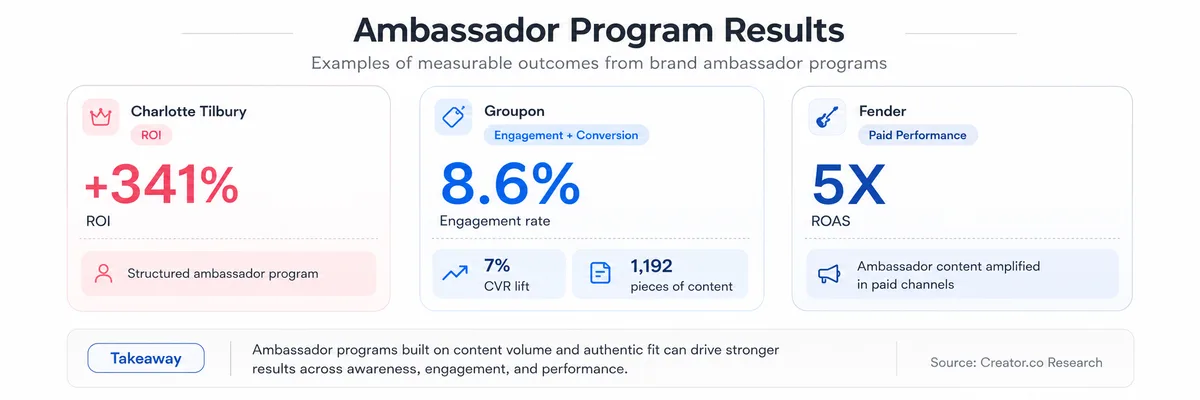
Real-world results from brand ambassador programs demonstrate the power of authentic creator partnerships in driving ROI, engagement, and paid performance across multiple platforms.
How to start a brand ambassador program: 7 steps
1. Define program goals tied to business outcomes
Starting with "we want more brand awareness" is not a goal. Start with a specific business problem: new customer acquisition in a specific demographic, UGC volume for paid ads, regional market penetration, or reducing cost-per-acquisition on performance channels.
The goal determines everything downstream. If you need UGC volume for paid ads, you will recruit differently than if you need local market activation. Set a measurable target before you build anything else.
2. Build your ideal ambassador profile
Most brands skip this step or define it too loosely. Ambassador profile work goes beyond follower count. The relevant questions are: What values does this person hold that overlap with our brand? What does their content style look like, and does it match where our customers spend time? Does their audience actually overlap with our buyer profile?
Psychographic fit matters more than demographic fit at this stage. A 25-year-old fitness creator with 8,000 followers who genuinely trains every day and talks about recovery is worth more to a supplement brand than a 200,000-follower lifestyle account that posts about everything. Define the profile with specificity before you start recruiting.
3. Decide on compensation and incentives
The compensation model you choose signals the kind of ambassador you will attract. Cash-only arrangements tend to attract people optimizing for income, not advocacy. The best ambassador programs use a spectrum: product gifting as the baseline for new ambassadors, commission structures that reward performance, and hybrid tiered models that escalate rewards as ambassadors demonstrate results.
A tiered structure also gives you a retention mechanism. An ambassador who starts with gifting and earns their way into a commission tier has a reason to stay engaged and grow within the program. That internal development ladder is one of the most underused tools in ambassador program design.
4. Create a recruitment process
Your best ambassadors are often already in your ecosystem. Start with existing customers who are posting about your product organically. Social listening tools will surface who is already talking about you without being paid to do so.
For brands that need to scale beyond their existing customer base, platform databases dramatically accelerate recruitment. Creator.co has 270K+ registered creators and an extended database of 400M+ profiles. The ability to search by niche, engagement rate, audience demographics, and content style means you can find the right fit before you spend a dollar on outreach.
5. Brief ambassadors like partners, not vendors
The quality of your ambassador content is directly tied to how well you onboard them. A strong ambassador onboarding kit includes brand guidelines, product information, clear deliverables, and examples of content that has performed well. It also includes creative freedom within those guardrails.
The brands that get the worst output are the ones that over-script. A musician ambassador for Fender does not need to be told how to talk about a guitar. They need to know what the campaign is trying to achieve, what the deliverables are, and what they cannot say or show. Everything else should be their voice. Treat ambassadors like collaborators, and the content will reflect that.
6. Track performance with the right metrics
Engagement rate is the primary quality signal for ambassador content. For micro ambassadors (typically 10K to 100K followers), a benchmark of 3-6% is a reasonable target. Below that, the content is not connecting. Above it, you have someone worth investing in further.
Track cost-per-piece alongside engagement rate to understand efficiency. CVR lift tells you whether the content is actually moving purchase intent, not just generating likes. UGC output volume matters if you are building a content library for paid ads. Set these metrics before the program launches, not after you are trying to explain results.
7. Retain and graduate ambassadors
Most ambassador programs focus entirely on recruitment and almost nothing on retention. This is a mistake. The compounding value of an ambassador comes from the long-term relationship, not the first few posts.
Build a tiered structure that rewards top performers with better compensation, exclusive product access, co-creation opportunities, or public recognition. Ambassadors who feel like they are growing within your program stay longer and produce better content. The ones who feel like a number on a spreadsheet churn out after one campaign cycle.
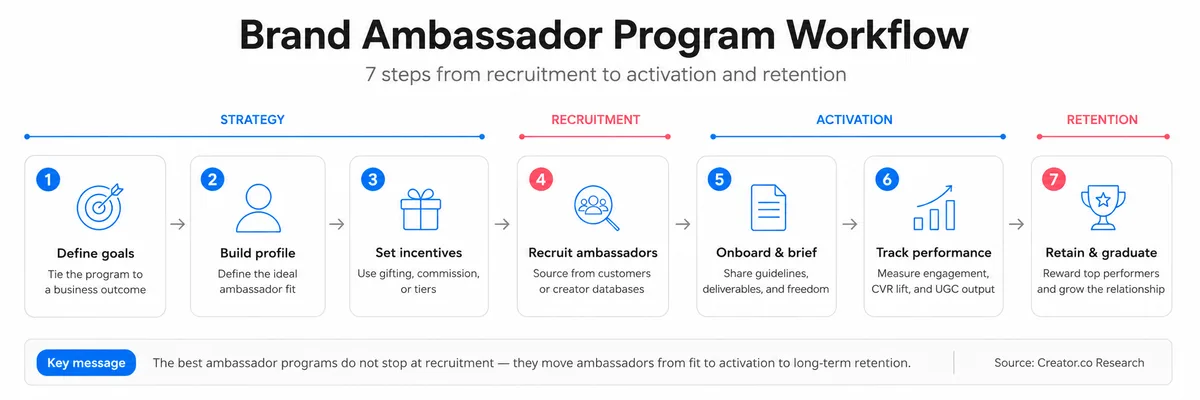
The complete brand ambassador program workflow spans seven strategic steps, from initial strategy and recruitment through activation and long-term retention to maximize influencer partnership ROI.
Brand ambassador program examples: what great programs look like
Fender built its ambassador program around one core insight: musicians trust other musicians. By recruiting working players across genres, Fender generated content that felt native to the communities where gear decisions get made. The 5X ROAS on paid amplification of that content shows what happens when you take authentic UGC and put media budget behind it. The content did not need to be made to look organic. It already was.
Nike's athlete ambassador model operates at a different scale but on the same principle. The athletes Nike works with are credible users of the product, not just famous faces. That distinction matters. When a sponsored athlete says a shoe changed their training, it lands differently than a celebrity endorsement because the athlete is the target customer. Brand credibility and aspiration compound over years, not campaign cycles.
For DTC brands, the model often starts closer to home: loyal customers who already post about the product, offered a structured gifting relationship in exchange for consistent content. This approach generates UGC that feeds both organic social and paid channels, often at a cost-per-piece that traditional creative production cannot match.
Across all three models, the common elements are genuine product affinity, a clear program structure with defined deliverables, and the patience to let relationships develop over time rather than optimizing for a single campaign spike.
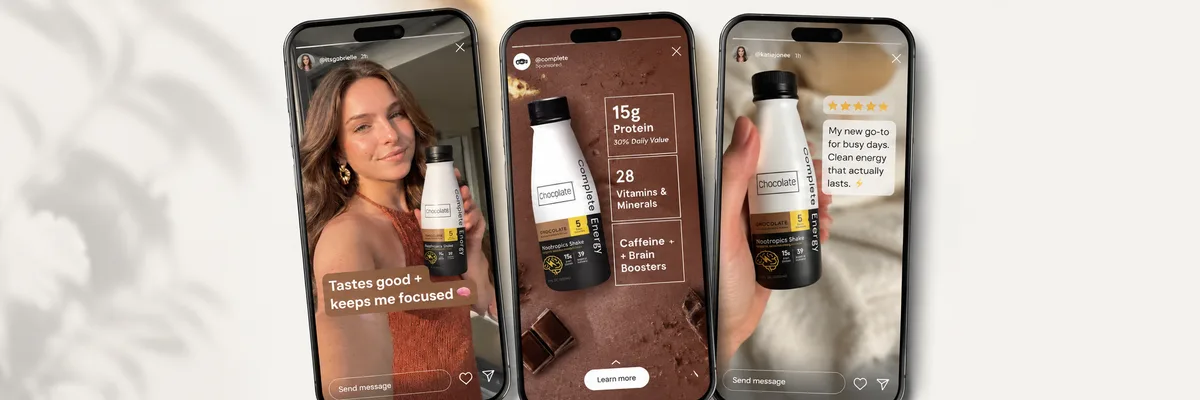
Influencers leverage authentic storytelling in sponsored Stories to promote functional nutrition products, highlighting real benefits like sustained energy and protein content to engage their audiences.
Understanding how ambassador content feeds into broader paid and organic strategies is worth reading alongside this. The relationship between UGC and influencer campaigns explains how to use ambassador-generated content across channels for maximum return.
Ambassador vs influencer: when to run which
These two models are not in competition. They serve different objectives, and understanding when to use each one is a strategic advantage.
Run an ambassador program when you need consistent content volume over time, when you are in a category where trust is the primary purchase driver (health, wellness, finance, outdoor, parenting), or when you want to build a recognizable community around your brand. Ambassador programs compound. The longer they run with the right people, the stronger the returns.
Run influencer campaigns when you need reach quickly, when you are launching a new product and need broad awareness in a compressed window, or when you want to test multiple audience segments simultaneously. Influencer marketing is a high-velocity, high-reach play. It is excellent for launches and awareness spikes.
The two work together more often than they compete. A well-run ambassador program gives you a foundation of ongoing content and genuine advocacy. Influencer campaigns layer on top for awareness events. The brands that combine both, using ambassador content as creative fuel for paid media while using influencer campaigns for reach at launch, tend to see the strongest overall performance.
Creator.co is built to support both models from one platform, so you are not managing two separate vendor relationships when your strategy spans both.
Setting up your ambassador program with the right platform
Manual ambassador management does not scale. At fewer than 20 ambassadors, spreadsheets and email threads are manageable. Past that point, tracking deliverables, chasing content approvals, managing payments, and pulling reporting across dozens of relationships becomes a full-time job that produces error and inconsistency.
A purpose-built brand ambassador platform should handle creator sourcing, brief management, content rights and approvals, payment automation, and campaign reporting in one place. Without those capabilities integrated, the operational load of running a program at scale eats the margin.
Creator.co is a G2 Leader (Spring 2026) with 270K+ registered creators and a 400M+ creator database for sourcing. Brands using the platform save 15 to 20 hours per campaign on average. The brands running programs on Creator.co include Nike, Mercedes-Benz, Fender, and Oakley, which reflects the platform's ability to support programs from DTC scale through global enterprise.
The practical first milestone for any new program: get your first brief posted and your first ambassador activated within two weeks of platform access. That timeline is achievable, and hitting it creates momentum that sustains the program through its first 90 days.